FitHelix Science · Nutrition
9 min readWhat Is a Calorie? Can Controlling Calories Help With Weight Loss?
What one Calorie number can — and cannot — tell you about a meal.

Energy can share one unit. What a food contains still needs a closer look.
A Calorie Is a Unit of Energy

One unit, many uses
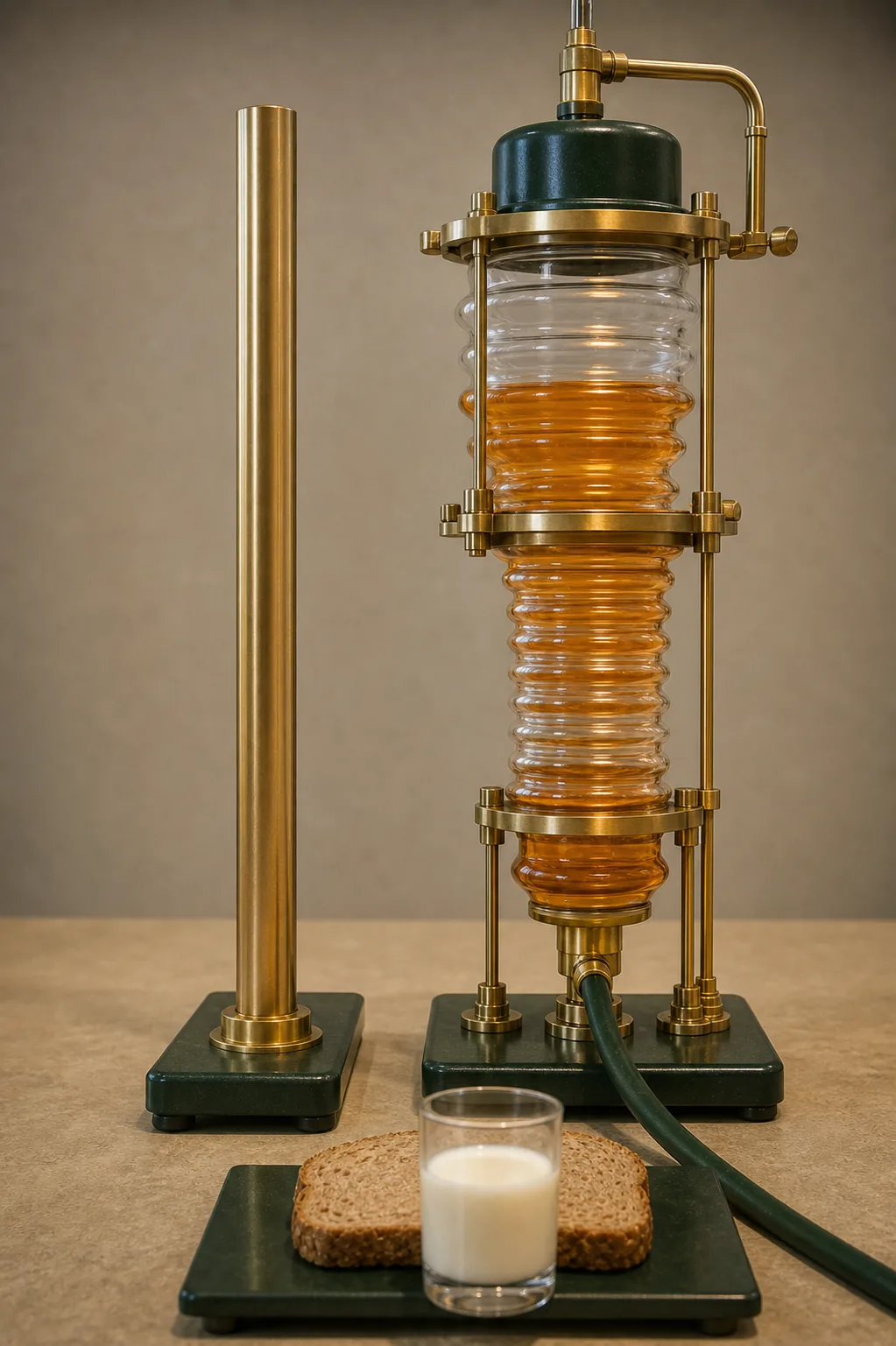
Bread, milk, and a lamp can share one energy unit without becoming the same thing.
Pick up a food package and it might say "230 Calories." A treadmill might display "230 Calories burned." One number describes what you take in; the other, what your body uses. They use the same unit: energy.
Think of the kilowatt-hour on your electricity bill. It tells you how much electricity you used, not whether it powered the lights, the oven, or the air conditioner. A calorie does something similar: it measures energy. How nutritious the food is, or how long it keeps you full, takes more than that one number.
The "230 Calories" on the label actually means 230 kilocalories (kcal). One kilocalorie was originally defined as the energy needed to raise the temperature of one kilogram of water by one degree Celsius. That sounds like a physics-class detail, but it has a practical use. Once you have a shared unit, you can compare roughly how much energy a cup of milk and a slice of bread provide.
How Labels Calculate Calories
Manufacturers do not need to light every cracker on fire. Nutrition labels can build the calorie number from a food's protein, carbohydrate, and fat.
Protein × 4 + Carbohydrate × 4 + Fat × 9
Add the three estimates, then apply label rounding and serving rules.
The arithmetic is straightforward: grams of protein times 4, grams of carbohydrate times 4, grams of fat times 9, then add them up. The result gets rounded according to labeling rules, so the number on the package is a standardized estimate, not a laboratory receipt accurate to the last crumb.

Estimate first, serving second
A label estimates from nutrients, rounds the result, and reports it per serving.
There is a small phrase that is easy to skip: "per serving." If a pack holds two servings and the label says 230 Calories per serving, eating the whole pack means eating two servings. Often, what throws the numbers off is not the multiplication. It is thinking one pack equals one serving.
Can Calorie Control Reduce Weight?
Yes.
Your body does not stop working when you sit still. Breathing, heartbeat, staying warm, and digesting food all use energy. Moving around and exercising add more. If, over time, you take in less energy than your body uses, that gap is what people call a "calorie deficit," and body weight generally goes down.

A gap over time
The direction comes from the sustained gap, not a single meal.
What the research found
One two-year trial assigned 811 adults with overweight or obesity to four different diets. The diets varied in fat, protein, and carbohydrate, but they shared a common target: reduced calories. On average, participants lost about 13 pounds after six months and were still about 9 pounds below their starting weight after two years. Weight loss was similar across all four groups.
Participants lost similar average amounts across the four diet patterns. That does not mean one menu works for everyone. They did not only receive a calorie goal. They tracked their food, had regular counseling sessions, and were encouraged to move. The results cannot be pinned on a calorie log alone.
Why Weight Does Not Follow a Fixed Formula
Because a human body is not a space heater with a fixed wattage.
A moving target
Energy needs and estimates can change, so the line does not stay fixed.
At first, a calorie target might create a real deficit. But as weight drops, a lighter body usually needs less energy to keep running. During weight loss, metabolism and other factors change too. Even if your plate looks the same, the gap can slowly narrow.
Your calorie intake estimate is rough to begin with. Labels round. A bowl of rice you serve yourself may not match the serving listed on the package. Restaurant meals make it even harder to estimate oil and portion size. Put these rough estimates into a fixed equation and you will get a precise-looking answer, but decimal points do not make it a personal forecast.
Energy balance still matters. The trouble starts when it is treated as an unchanging conversion table. A calorie target can help you watch the overall trend over time, but it cannot promise exactly what the scale will show next week.
Controlling Calories Does Not Require Counting Them
Some people like tracking. Numbers help them notice that a bowl of cereal was actually two servings, or that a drink accounted for a surprising share of the day's energy. Others find that logging turns every meal into a math problem.

More than one route
Tracking can help, but changing familiar foods and portions is another route.
Do not miss the study conditions
A 2018 trial assigned 609 adults with overweight or obesity to either a healthy low-fat eating pattern or a healthy low-carbohydrate one, without setting a fixed daily calorie goal. Over twelve months, participants learned to adjust what they ate, cooked differently, and practiced maintaining those changes. At the end, the low-fat group had lost about 5.3 kilograms on average and the low-carbohydrate group about 6.0 kilograms. Both groups also reported eating fewer calories than when they started.
Those averages look different, but the research team found no clear statistical difference between the diets. Within each group, some people lost more and some did not lose weight. Everyone attended 22 group sessions, a level of support well beyond what most people get in everyday life.
In this study, reducing total energy did not begin with an exact daily number. Some people find a tracker helpful because it can reveal portion drift and energy in drinks. Others prefer to adjust the foods and amounts they already eat. Counting calories can help, but it is only one way to notice and maintain an energy gap.
What Calories Do Not Tell You
Two plates can show the same calorie count yet contain different amounts of protein, fiber, vitamins, minerals, and sodium. Their size, texture, fullness, and whether you would want to eat them regularly may feel nothing alike.

What the total leaves out
Energy matters, and it is not the whole description of a meal.
A meal includes energy, nutrients, portion and texture, and your experience.
This does not contradict the calorie. Like an electricity bill, the total energy is real, but it cannot tell you whether the electricity ran the air conditioner or the oven. The total and the details are both real. When you want to know how much energy a food provides, look at Calories. To decide whether it fits this meal, you also need to look at ingredients, nutrients, portion size, and how it actually feels to eat.
Controlling total energy intake can support weight loss. Calories are useful information, not a complete description of a meal.
What to carry forward
Controlling total energy intake can help with weight loss. Tracking each item is one method, not the principle itself.
Keep the boundary beside the conclusion
This article does not provide a personal daily calorie target, deficit, or expected pace of weight loss. Pregnancy, periods of growth, an eating disorder, and certain metabolic or digestive conditions can change individual needs. If tracking food makes you afraid to eat, leads you to intentionally skip food, or prompts excessive exercise to "make up" for Calories, stop tracking and seek support from a qualified professional.
Sources
- Calories on the Nutrition Facts Label. · official regulatory guidance · 2024
- 21 CFR 101.9 - Nutrition labeling of food. · federal regulation · 2026
- Dietary Reference Intakes for Energy. · DOI 10.17226/26818 · PMID 36693139
- Overweight and obesity management - Physical activity and diet. · official clinical guidance · 2025
- Eating and Physical Activity to Lose or Maintain Weight. · official public health guidance · 2026
- Comparison of Weight-Loss Diets with Different Compositions of Fat, Protein, and Carbohydrates. · DOI 10.1056/NEJMoa0804748 · PMID 19246357
- Effect of Low-Fat vs Low-Carbohydrate Diet on 12-Month Weight Loss in Overweight Adults. · DOI 10.1001/jama.2018.0245 · PMID 29466592
- A systematic review of the use of dietary self-monitoring in behavioural weight loss interventions. · DOI 10.1017/S136898002100358X · PMID 34412727
- Body Weight Planner. · official dynamic model · 2026