FitHelix Science · Nutrition
10 min readSame Calories, Different Sources: Protein, Carbs, and Fat
One energy total — but the source still changes how a meal digests and feels.
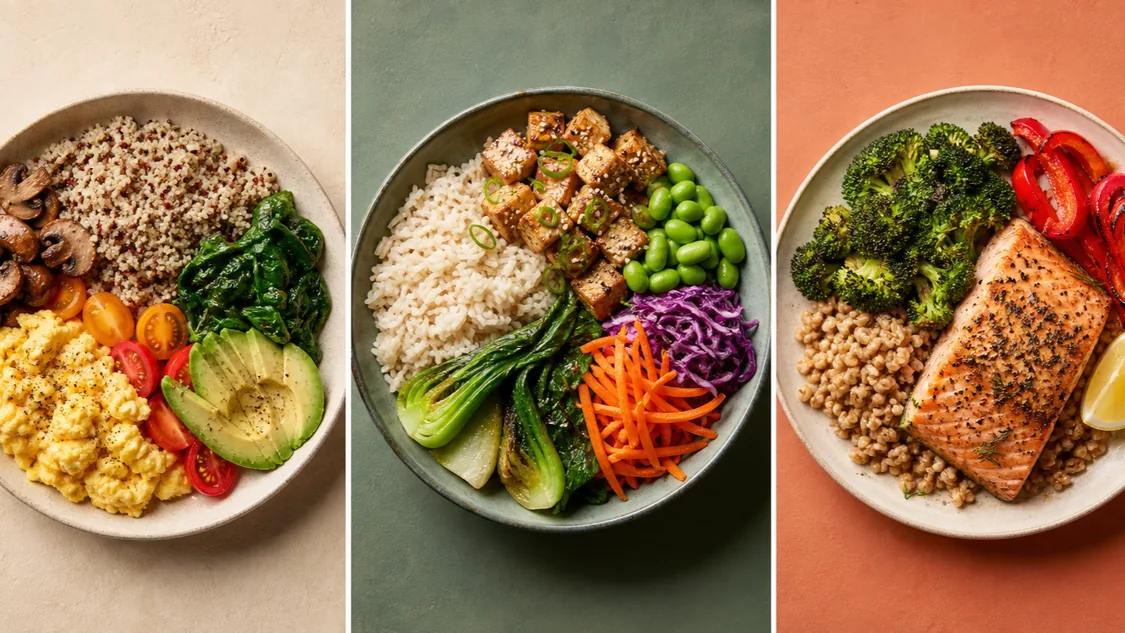
Three ordinary mixed meals, one shared energy unit
These meals are editorial examples, not trial meals or equal-Calorie comparisons. They show that ordinary mixed meals can share one energy unit while their composition still differs.
One plate, more than one number

An ordinary meal is already mixed
This is an editorial illustration. Rice, egg, vegetables, and cooking oil make one meal, not three isolated nutrient boxes.
Put a bowl of rice next to a fried egg and some sautéed greens. Most of us can name the parts: the rice is “carbs,” the egg is “protein,” and the cooking oil is “fat.” The shorthand is useful, but it makes the plate look tidier than it is.
The egg also contains fat. Rice is not pure carbohydrate. The greens bring water, fiber, and other nutrients. By the time you lift the fork, you have a mixed meal, not three ingredients sitting in separate nutrition boxes.
A Nutrition Facts label can turn the whole plate into one energy total. That number answers a real question: how much energy does this food provide? It does not tell you what the food is built from or how the meal may feel afterward. For that, we have to follow the food past the Calorie line.
What 4–4–9 actually counts
The familiar label math goes like this: carbohydrate provides about 4 Calories per gram, protein about 4, and fat about 9. Multiply the grams by those numbers, add the results, and you have an estimate of the food’s energy.
4 / 4 / 9 converts to one unit
This common label estimate is not a personal absorption formula or a score of whether a nutrient is good or bad.
Think of 4–4–9 as a conversion table. It puts three different materials into one common unit. The numbers are general estimates, not a reading of what one person will absorb from one meal. Labels may use more specific factors for some foods, handle non-digestible carbohydrate separately, and round the result. That is why arithmetic done at home will not always reproduce the printed total exactly.
Fat’s 9 Calories per gram means that it carries more energy in the same weight. It is not a score for whether the food is good or bad. The formula has finished its job once it estimates energy. What happens after you eat is a different question.
Past the label, the meal comes apart
On the label, carbohydrate and protein happen to share the number 4. In the digestive tract, the resemblance quickly disappears.
Different materials, overlapping jobs
Carbohydrate is broken into small sugars, including glucose, fructose, and galactose. Protein becomes short protein fragments, called peptides, and amino acids. Fat is dispersed, split apart, absorbed, and partly repacked into particles that can travel through the body.
All three can take part in supplying energy. The body also uses them as materials for other work. Amino acids help make body proteins. Fat contributes to cell structure and helps the body absorb fat-soluble vitamins. Carbohydrate supplies sugars the body can use. The jobs overlap, and each nutrient can have more than one destination. They still are not interchangeable building materials.
Digestion has an energy bill
A meal does not simply slide through a tube. Breaking food down, absorbing it, moving its parts around, and processing them all require energy. Researchers call this the thermic effect of food, or diet-induced thermogenesis.
Looking across 52 studies
A 2024 meta-analysis—a study that combines results from many studies—looked at 52 trials. In the hours after a meal, higher-protein meals produced a larger thermic effect on average than lower-protein meals. The size of the difference varied across study designs and groups of people. When researchers looked at diets followed for 4 days to 1 year, they did not find a clear difference in thermic effect between the higher- and lower-protein groups.
The authors also disclosed relationships with food and health companies. That does not erase the result, but it belongs beside the result when we judge how much weight to give it.
Protein’s higher short-term processing cost is interesting biology. It is a poor discount code for the Nutrition Facts panel. A study average cannot tell you the “net Calories” in your dinner or how much weight one person will lose.
The label has no line for fullness
Two meals can contain the same Calories and leave people feeling quite different a few hours later. In some controlled studies, participants reported more fullness after a higher-protein meal.
Fullness is a measurement, not the final outcome
The details are less decisive. A 2016 meta-analysis found only 5 studies that met its strict criteria. Those studies did report greater fullness after higher-protein test meals. A 2020 review looked at 10 articles involving 1,079 adults with overweight or obesity. Six of the 10 reported greater fullness or satiety with more protein, yet the authors rated the overall evidence as low because the methods varied and the studies had a high risk of bias.
Fullness is a feeling reported at a point in time. It does not prove that someone will eat less later, and it does not promise weight loss. Water, fiber, texture, portion size, and the rest of the meal also shape the experience. Protein is one part of the picture, not an appetite forecast.
What changed when almonds were ground
Macronutrient percentages are not the whole Calorie story. The physical structure of a food can affect how much energy the body actually obtains.
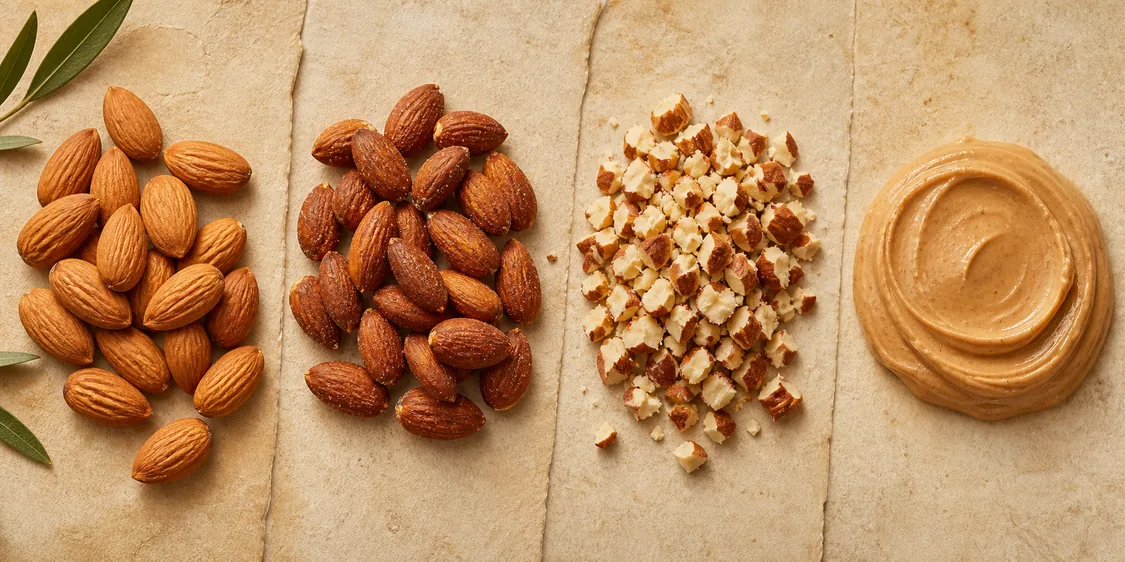
From whole almonds to almond butter
Whole natural, whole roasted, chopped, and ground were the four forms compared in this 18-person trial.
In a controlled crossover trial, 18 adults moved through several test diets that included different forms of almonds. Researchers measured 4.42 Calories per gram for whole natural almonds, 4.86 for whole roasted almonds, 5.04 for chopped almonds, and 6.53 for almond butter. The food changed form, and the measured metabolizable energy—the energy available to the body—changed with it.
Food processing and structure impact the metabolizable energy of almonds. 2016
The available energy differed across almond forms
18 adults · controlled crossover feeding trial
Whole natural
4.42 Calories/g
Whole roasted
4.86 Calories/g
Chopped
5.04 Calories/g
Almond butter
6.53 Calories/g
Measured available energy per gram (Calories/g)
This comparison covers four almond forms; it cannot supply a universal absorption adjustment for all nuts or processed foods.
Average measured available energy increased from whole natural almonds to almond butter.
What this result cannot show
The difference is striking, and it is also very specific. This was a small trial of almonds in four forms. It does not provide a general correction factor for every nut, whole food, or packaged food, and it does not make labels meaningless. A different food needs its own evidence.
The experiments that would not pick a winner
Protein can cost more energy to process and may feel more filling. Fat carries more energy per gram. Either observation can be turned into a neat diet verdict. Human trials make the verdict much less neat.

No winner at the center of the table
These are editorial meal examples, not trial meals or equal-Calorie comparisons. They carry one idea: research has not selected one macro ratio for everyone.
Two trials, two time scales
In 2015, 19 adults with obesity stayed in a metabolic ward, a research unit where investigators tightly controlled the food. Each person completed two 6-day reduced-Calorie diet periods. One period cut more carbohydrate; the other cut more fat. During carbohydrate restriction, insulin fell and fat oxidation—the body’s use of fat for energy—increased. Yet during this short experiment, cutting fat produced slightly more body-fat loss, Calorie for Calorie. The rise in fat burning during the low-carbohydrate period did not produce more body-fat loss in this short study.
Calorie for Calorie, Dietary Fat Restriction Results in More Body Fat Loss than Carbohydrate Restriction in People with Obesity.Then consider a much longer study. The POUNDS LOST trial assigned 811 adults with overweight or obesity to 4 reduced-Calorie diets with different targets for fat, protein, and carbohydrate. After 2 years, average weight loss was similar across the groups. The participants also received counseling, kept food records, and were encouraged to be active. Over time, adherence declined and the actual differences among the diets became smaller.
Comparison of Weight-Loss Diets with Different Compositions of Fat, Protein, and Carbohydrates.These studies answer different questions. One watched 19 people under tight control for days. The other followed 811 people for 2 years with substantial support. Neither supplies a universal case for low-fat, low-carbohydrate, or high-protein eating.
Return to the Nutrition Facts label. The Calorie line tells you about total energy. The protein, carbohydrate, and fat rows tell you something about the materials carrying that energy. Neither view can stand in for the whole meal, but both are useful. The label was never wrong; we were asking one number to do too many jobs.
What to carry forward
Calories measure total energy. Protein, carbohydrate, and fat can change digestion, fullness, and some metabolic processes, but current research has not crowned one best mix for everyone.
Keep the boundary beside the conclusion
This article does not provide personal protein grams, macro ratios, Calorie targets, or recommend low-fat, low-carbohydrate, or high-protein diets. People with diabetes, digestive or metabolic conditions, or those who need clinical nutrition therapy should not use it in place of professional advice. If counting Calories or macros makes you fear certain foods, skip meals on purpose, or compensate with exercise, consider pausing tracking and seeking qualified support.

Sources
- Dietary Reference Intakes for Energy. · DOI 10.17226/26818 · PMID 36693139
- How to Understand and Use the Nutrition Facts Label. · official regulatory guidance · 2024
- Food Labeling - Revision of the Nutrition and Supplement Facts Labels - Guidance for Industry. · official regulatory guidance · 2020
- Physiology, Nutrient Absorption. · clinical physiology reference · 2025
- How Cells Obtain Energy from Food. · cell biology reference · 2002
- Dietary Intake of Fat in Relation to Growth, Development, and Risk of Chronic Disease. · federal systematic evidence report · 2026
- Effects of Varying Protein Amounts and Types on Diet-Induced Thermogenesis. · DOI 10.1016/j.advnut.2024.100332 · PMID 39486625
- The Energy Content and Composition of Meals Consumed after an Overnight Fast and Their Effects on Diet Induced Thermogenesis. · DOI 10.3390/nu8110670 · PMID 27792142
- The Effects of Increased Protein Intake on Fullness - A Meta-Analysis and Its Limitations. · DOI 10.1016/j.jand.2016.01.003 · PMID 26947338
- Dietary protein and appetite sensations in individuals with overweight and obesity. · DOI 10.1007/s00394-020-02321-1 · PMID 32648023
- Food processing and structure impact the metabolizable energy of almonds. · DOI 10.1039/c6fo01076h · PMID 27713968
- Calorie for Calorie, Dietary Fat Restriction Results in More Body Fat Loss than Carbohydrate Restriction in People with Obesity. · DOI 10.1016/j.cmet.2015.07.021 · PMID 26278052
- Comparison of Weight-Loss Diets with Different Compositions of Fat, Protein, and Carbohydrates. · DOI 10.1056/NEJMoa0804748 · PMID 19246357